

New Flexibility Needs Assessment supports a renewable-led electricity system
14th October 2026
Offaly leading the way in renewables and biodiversity
14th October 2026Biomethane target ‘could cut farm inequality’
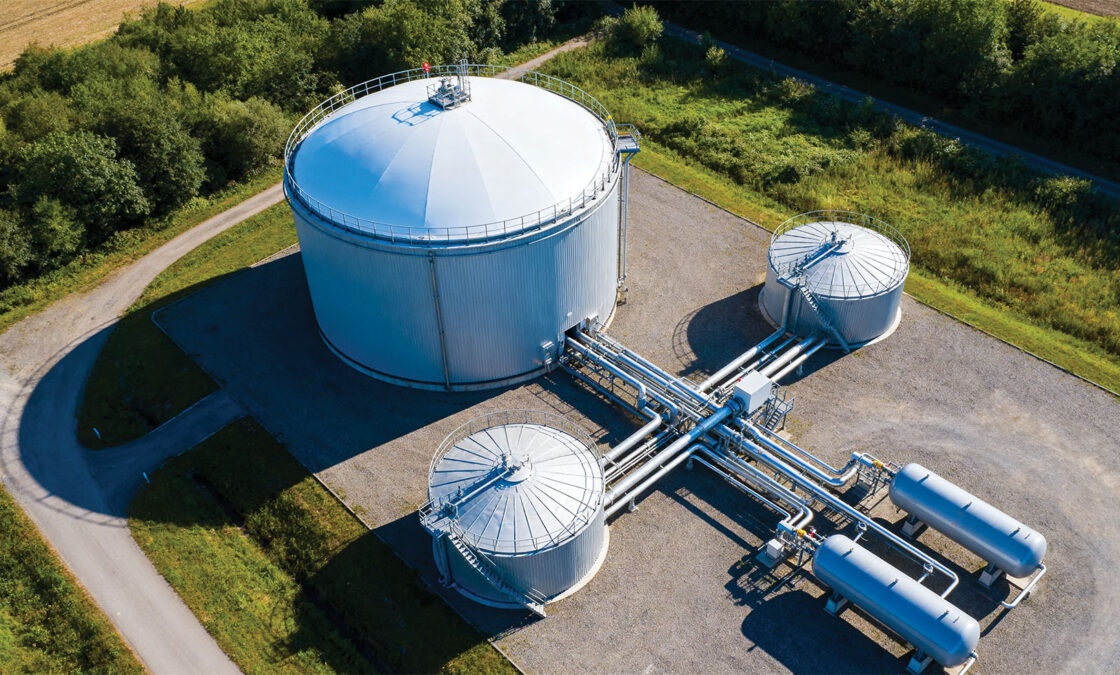
Reaching Ireland’s 2030 target of producing 5.7TWh of biomethane could increase incomes among lower-income cattle farms and reduce inequality across the agricultural sector, according to new ESRI research.
Fuelling Change: The distributional and climate impacts of farmers supplying biomethane feedstocks in Ireland, by Anita Vollmer, Miguel Tovar Reaños, and Muireann Lynch, finds that using agricultural land to produce biomethane feedstocks could support a “just energy transition”, but would involve a trade-off between reducing inequality, maximising emissions reductions, and keeping abatement costs down.
The study focuses on Ireland’s target of producing 5.7TWh of biomethane annually by 2030. It uses data from the Teagasc National Farm Survey and a microsimulation model to assess which farms would switch to biomethane feedstock production under four different scenarios. The four scenarios are as follows:
- farm efficiency;
- farm profitability;
- emissions reduction; and
- a partial-conversion scenario in which farms retain livestock while converting part of their land to biomethane silage.
Income distribution
The most significant distributional finding concerns lower-income cattle farms. Under the profit scenario, around 3,058 farms would switch completely to biomethane silage production. Almost all of these would be cattle farms, with an average family farm income of just €5,431 compared with €34,202 across the overall farming population.
For these farms, switching would increase average cattle farm income by 8.7 per cent. Overall farm income would increase by 2.6 per cent, while inequality, measured using the Gini coefficient, would fall by 3.4 per cent.
The authors therefore identify a potential distributional benefit from directing biomethane production towards lower income farms. However, they caution that the very low incomes of these farms raise questions about whether they would actually have the resources or motivation to make the transition.
The farms most likely to switch under the profit scenario are relatively extensive, low-intensity farms. Removing livestock production from these farms could therefore result in livestock production becoming more concentrated among higher-intensity farms.
The ESRI authors describe this as a concern because “the most environmentally sustainable and extensive farms would be those transitioning away from livestock farming, leading to a consolidation of livestock farming into high-intensity farms”.
Emissions reduction
For the alternative climate scenario, the model selects farms with the highest greenhouse gas emissions per hectare. Around 4,058 farms would need to switch completely to biomethane silage, with an average stocking rate of 2.5 livestock units per hectare.
This produces the greatest emissions reduction of the scenarios examined: approximately 2.1 MtCO2eq, compared with 1.7 MtCO2eq under the efficiency scenario and 1.6 MtCO2eq under the profit scenario. The partial conversion scenario produces approximately 1.4 MtCO2eq of abatement.
The report models that climate-focused farms experience significant income reductions, with average dairy-farm income falling by 7 per cent and cattle-farm income by 4.3 per cent. Overall inequality increases by 2 per cent.
The study consequently identifies a tension between the social and environmental objectives of biomethane policy. The authors conclude that “there is likely a trade-off between reducing inequality and other benefits”.
Can the 5.7TWh target be achieved?
Under the three full-conversion scenarios, between 5.8 per cent and 7.7 per cent of cattle and dairy farms would need to convert completely to biomethane silage production. However, these scenarios would require between approximately 17 million and 18 million m3 of slurry from farms not participating in biomethane production.
The partial conversion scenario avoids the need for imported slurry, but would involve 71.8 per cent of farms and would produce only 4.35TWh.
In this context, the ESRI concludes that under its assumptions “it may not be possible to reach the Government target of 5.7TWh biomethane from on-farm feedstocks alone”.
A high-cost form of abatement
All four scenarios have a marginal abatement cost above the ESRI’s assumed 2030 carbon shadow price of €408/tCO2eq. The climate scenario performs best on this measure, at €472/tCO2eq when biomethane replaces fossil gas for heat and €415/tCO2eq when used in transport. The other scenarios generally range between €500 and €600/tCO2eq for heat.
The report contextualises that these results are sensitive to the price achieved for biomethane. A substantially higher biomethane price could reduce the marginal abatement cost to between €300/tCO2eq and €400/tCO2eq in some circumstances.
The paper concludes that agricultural biomethane can contribute to a just energy transition, but that policymakers face competing objectives of reducing farm-income inequality, maximising emissions reductions, and minimising the cost of abatement.
Importantly, the farm data available for the analysis dates from 2017 and the model lacks sufficient spatial information to determine whether the required slurry would be available close enough to proposed biomethane plants.