

Offaly leading the way in renewables and biodiversity
14th October 2026
Helping Irish SMEs become more sustainable
14th October 2026Ireland’s energy transition: Past and future

Brian Ó Gallachóir, associate vice president of sustainability and director of the Sustainability Institute at University College Cork, reflects on Ireland’s energy transition over the past 30 years and looks ahead to the next 30.
Demonstrating the implications of geopolitical events on oil prices, Ó Gallachóir outlines that the 1973 Yom Kippur War, the 1979 Iranian Revolution, and 2026 US and Israeli attacks on Iran led to spikes.
“If you have a high dependence on oil, your economy and your society is exposed to the vulnerability of not knowing what is next, but you can anticipate that there will be at least periods of very high oil prices,” says Ó Gallachóir.
He asserts that the Strait of Hormuz disruption has been labelled the largest energy security event in history by the International Energy Agency. This is due to the quantity of oil trapped in the strait which is estimated to be up to 20 million barrels per day. Ó Gallachóir says this “dwarfs the oil supply restrictions that we faced in the 1970s”.
“When you see our energy supply mix as it currently stands against the context of energy price changes and the economic losses from climate change, there is an element of apparent madness in that.”
However, he says the context is very different. In the west, mechanisms such as strategic oil reserves are in place today which were not during the 1970s. Ó Gallachóir says this has enabled the west to “cushion the blow”.
“But many countries in the east are facing much more significant impacts of the current oil supply disruption than we are,” he adds.
Ó Gallachóir says there are regular discussions on the economic impact of net zero strategies, but that there are less discussions on the economic impacts of climate change. Climate change incurred estimated economic losses in the EU of €822 billion between 1980 and 2024. Of these losses, around 25 per cent (€208 billion) occurred between 2021 and 2024.
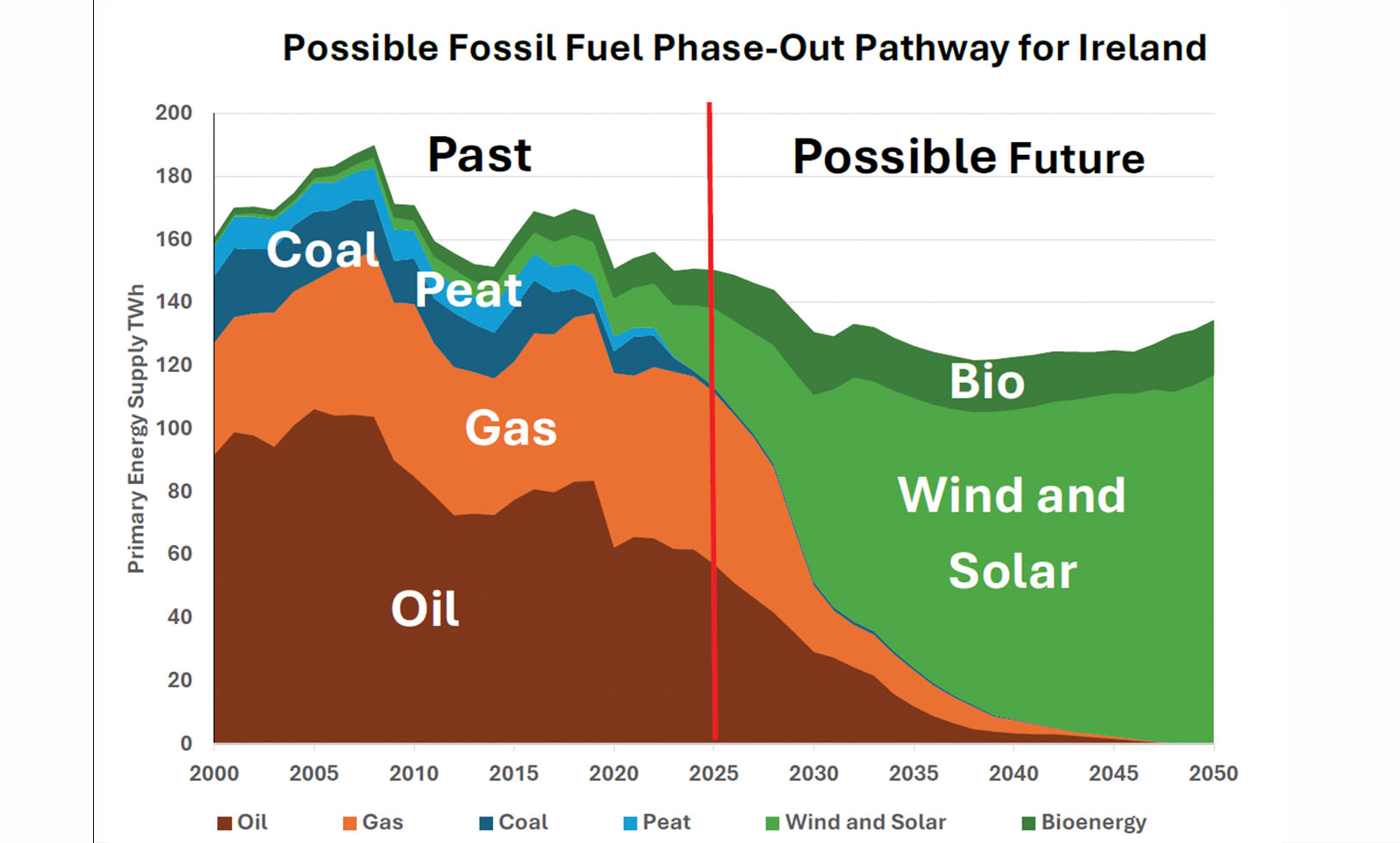
Ó Gallachóir outlines that fossil fuels accounted for 83 per cent of Ireland’s energy mix in 2025 while renewable energy accounted for 17 per cent. He says: “When you see our energy supply mix as it currently stands against the context of energy price changes and the economic losses from climate change, there is an element of apparent madness in that.”
Energy transition accelerating
However, Ó Gallachóir indicates that this is changing and reflects on energy supply trends by fuel over the last 30 years. During the Celtic Tiger, energy supply grew, while the economic recession led to a reduction in energy supply. Between 2015 and 2025, total energy supply has not grown significantly but the share of renewable energy has increased.
Ó Gallachóir asserts that the energy transition “is very clearly underway” and has “really accelerated in the last 10 years”. He adds that fossil fuel usage has reduced by 29 per cent from its peak in 2008.
The energy expert explains that energy demand has also changed significantly over this period. Since 1995, demand for both electricity and transport energy has doubled while heat usage has reduced. Ó Gallachóir says the Celtic Tiger period saw significant growth in transport, while reductions were observed “all over” during the recession. He says the International Energy Agency has labelled the current period as “the age of electricity”.
Reducing emissions
The Sustainability Institute director says an increased policy focus on reducing greenhouse gas (GHG) emissions across the economy has driven many recent changes. This is demonstrated by the Climate Change Act 2021 which set a target to reduce emissions by 51 per cent by 2030 relative to 2018 levels. It also established the five-yearly carbon budgets.
Ó Gallachóir notes that the first carbon budget period is over, stating that finalised data will not be available until March 2027. He shared recent EPA estimates of GHG emissions for the carbon budget period 2021-2025 that were 294 MtCO2eq, which suggests the State has met its first carbon budget. However, Ó Gallachóir states that this challenges the common perception that the State is set to exceed the first carbon budget.
Continuing, he says that between 2018 and 2025, there has been a 15 per cent reduction in emissions. Ó Gallachóir says: “While we met the first carbon budget, our emissions reduction should be higher, it should be at about 23 per cent in order for Ireland to be on that trajectory for a 51 per cent reduction.”
He notes that this reduction has been achieved as the economy has increased by 36 per cent and the population has grown by 12 per cent. While he states that this is not enough to meet the 2030 targets, he says the 15 per cent reduction and meeting the first carbon budget are “very significant” achievements and evidence that the transition is underway.
Between 2005 when emissions peaked and 2025, overall GHG emissions have reduced by 28 per cent. Electricity emissions reduced by 58 per cent, which Ó Gallachóir describes as a “real breakthrough”. He says “there is a lot of system inertia” within transport which achieved an 11 per cent reduction. Additionally, heating achieved a 30 per cent reduction, while there was a 1 per cent reduction in agriculture.
Although there has been progress, Ó Gallachóir asserts that there is “such a long journey to go”, adding that fossil fuels continue to dominate the State’s energy mix. He says that achieving the 2050 target depends on the actions of politicians, society, and the energy industry.
“There is a huge amount of moving parts required to do that. But when you consider the costs that we are facing associated with our vulnerability of fossil fuels and the growing costs associated with dealing with climate change, it is a very significant prize.
“A whole-of-society effort is required to achieve this, but the benefits are hugely significant.”