Delivering renewable energy solutions through solid biomass
14th October 2026
The North’s ‘energy revolution’
14th October 2026Trading essential for energy transition

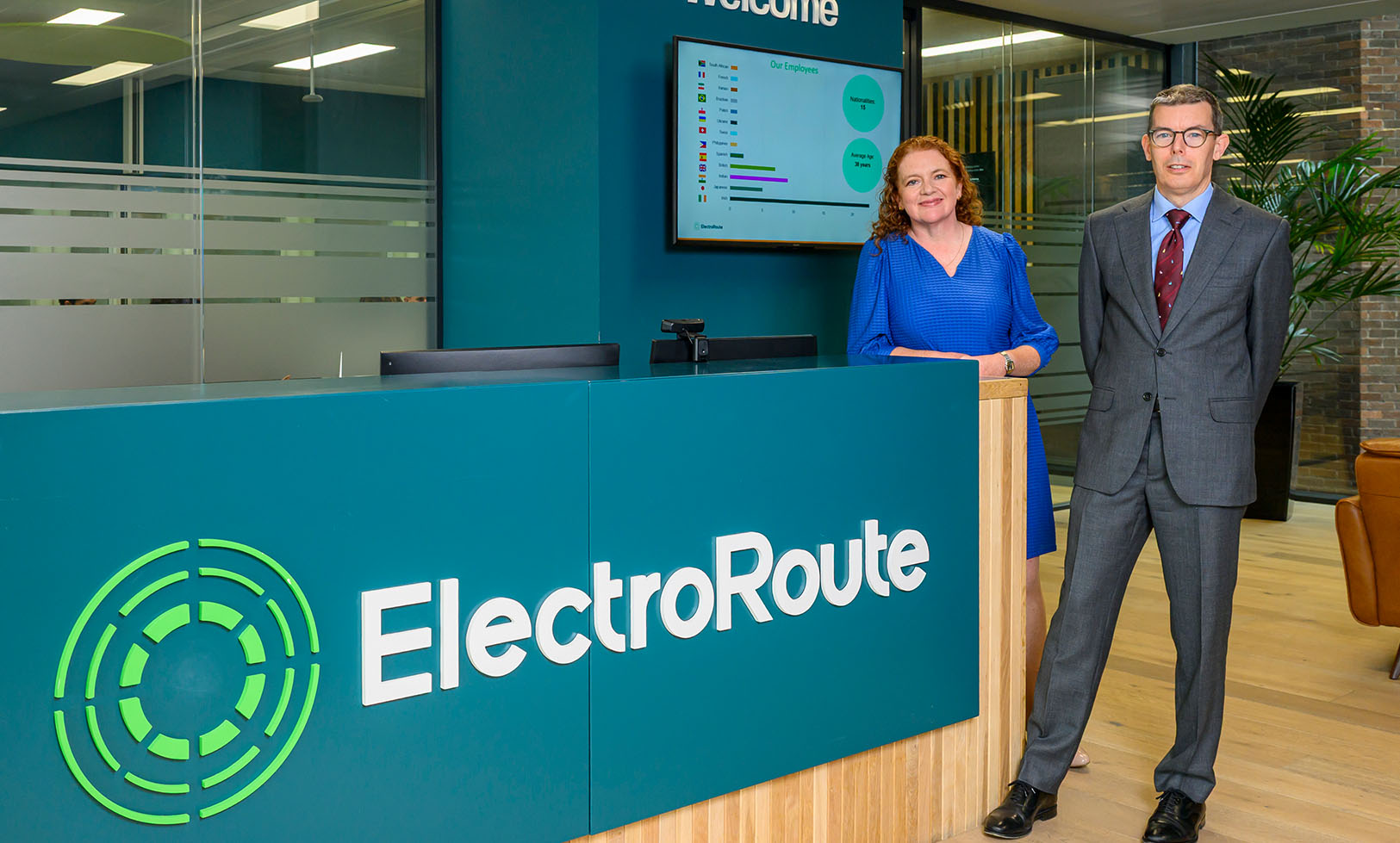
Energy Ireland’s Joshua Murray meets with the co-CEOs of ElectroRoute, Caoimhe Giblin and Donal Flynn, in their Dublin headquarters. The CEOs discuss the role of trading in the energy transition, the need for increased battery storage, and their company’s journey from a small startup to a significant international organisation in the 15 years since its foundation.
Fifteen years since its foundation, ElectroRoute has grown from a small Irish energy trading start-up into an international business managing more than 4GW of renewable and flexible energy assets.
However, for co-CEOs Caoimhe Giblin and Donal Flynn, the company’s origins remain closely tied to a relatively simple proposition: “When the founders were setting up the company, they were looking at how the energy transition was going to result in a demand for more innovative trading solutions. At the time, the only options were the utilities, so they decided to provide that type of functionality to the market,” Giblin says.
Founded at the height of the financial crisis, ElectroRoute initially focused on establishing the market infrastructure required to trade electricity independently. Its early activity centred on the interconnectors between Ireland and Britain, including the then recently commissioned East-West Interconnector.
“There was a lot of renewable power being wasted on the island of Ireland, so the team started by exporting that extra surplus of renewable power when it was cheap in Ireland and selling it into the Great Britain system.”
The company’s original proposition was therefore closely connected to the challenge that remains at the heart of the energy transition: renewable generation is increasingly abundant, but its output is variable and must be managed differently from conventional generation.
Flynn, who joined ElectroRoute in 2021 after group CFO roles with ESB and Glen Dimplex, says the founders recognised that renewables required a much greater level of market granularity.
“A historic base-load fossil plant will run at a certain level pretty much all the time, whereas solar or batteries or wind are much more variable. They go up and down. For renewables, it is necessary to forecast with a 15-minute granularity right from day one, and then manage variations on a 24/7 basis,” he says.
This understanding has become central to ElectroRoute’s business. In 2026, the company trades across wind, solar, hydro, batteries, combined heat and power, and other flexible assets in Ireland and Britain.
From Ireland to Japan
A significant milestone came in 2016, when Mitsubishi Corporation acquired a majority stake in ElectroRoute, subsequently moving to full ownership in 2022.
The CEOs explain that Mitsubishi saw an opportunity to take ElectroRoute’s expertise into Japan, where the energy market was undergoing its own process of deregulation and renewable investment.
“Japan is behind Europe in terms of deregulation of the energy market. ElectroRoute had been through that deregulation journey, that journey of renewables coming onto the system, and how you thrive in that environment,” Flynn explains.
He adds: “Part of our mandate in ElectroRoute was to build the platform we had in Europe over in Japan.”
The result has been a substantial Japanese business, with its operation now holding around 2GW of assets under management and approximately 50 people.
Giblin states that the Japanese expansion demonstrates the importance of combining local knowledge with expertise developed in another market. “It would have been very hard as an Irish company to do that without the local support of Mitsubishi,” she says.
“It was a unique mix of Mitsubishi and their strong name and connections and understanding of the Japanese market, combined with our experience and knowledge from having built a company like that in Europe.”
Flynn says the partnership worked because neither side attempted to replicate the other’s capabilities. “The culture and the language are very different, and I do not think it would be possible for an Irish business to go in there on its own. I think you need a trusted local partner, and we could not have had a better one than Mitsubishi Corporation.”
There was also a two-way transfer of expertise, with Japanese staff coming to Ireland for training and ElectroRoute personnel relocating to Tokyo.
“The recognition that Mitsubishi Corporation brought certain unique things, ElectroRoute brought certain unique things. I think both parties recognised the value the other was bringing,” Flynn says.
The case for trading
While ElectroRoute has expanded geographically, its core objective remains the optimisation of renewable and flexible assets.
For wind and solar, the challenge is that generators cannot determine when the wind blows or when the sun shines. The trading operation therefore needs to constantly assess market conditions and generation forecasts to determine how and when electricity should be sold.
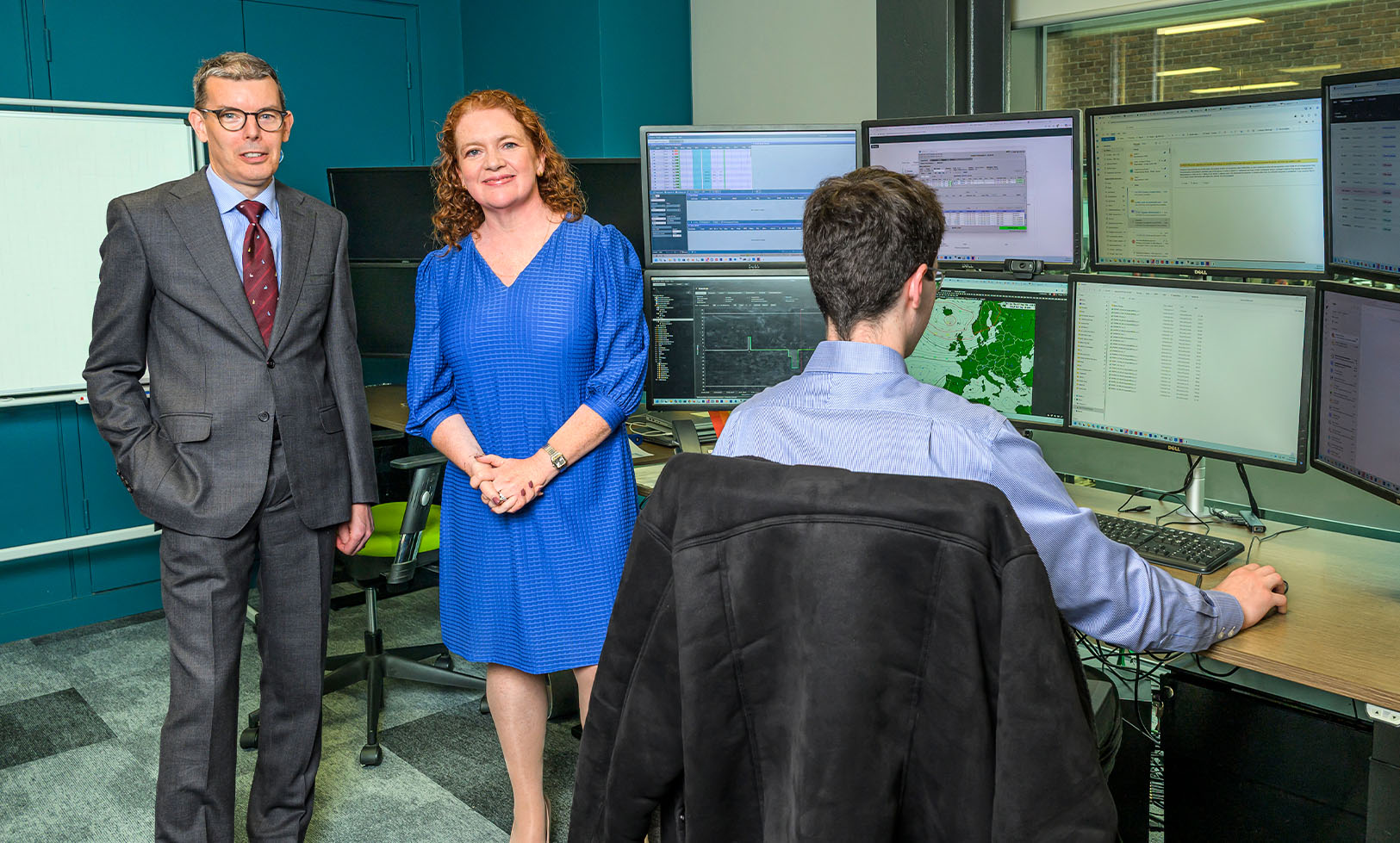
“We have a team of energy traders who work 24/7 here in Dublin who are in front of the screens all day, all night, and all year,” Giblin explains.
The company receives regular information from individual generating assets, allowing traders to assess current output, weather conditions, and plant availability.
“What our traders are doing is taking that information and deciding when to sell that power into the market, effectively in real time. It is very much about taking all the real-time information and making those trading decisions,” Giblin says.
The same principle becomes particularly important with batteries. “The success of a battery depends on charging it when prices are low, and discharging, selling the power back into the grid when prices are high,” she adds.
The trading desk therefore has to assess a range of variables including renewable generation and electricity demand, as well as gas generation and prices, in deciding when a battery should charge or discharge.
Flynn says ElectroRoute’s scale provides an additional advantage: “It is much more difficult to predict what is coming out of a single turbine versus hundreds of turbines and solar plants. We have a really helpful portfolio effect.”
The company’s scale also allows it to operate a 24-hour trading desk and benefit from information across multiple assets and geographical areas.
“We can see whether a weather system is hitting a plant that we look after in the southwest of the island before it hits the northeast. All of those things combine to give us relevance and a reason for having a role in the energy system,” Flynn says.
Batteries
The company’s focus is increasingly shifting towards flexibility, particularly battery storage. Giblin describes wind and solar as the company’s “bread and butter”, but says the next stage of the energy transition depends on finding ways to use renewable electricity when it is available and retain it for when it is needed.
“The other big growth area in terms of investment for the Irish system is around how to either store that energy or use that energy smartly,” she says.
“That encompasses batteries, flexible generation, and flexible demand. Whether it is flexible storage like batteries, flexible generation like peaker plants, or flexible demand, flexibility is key and it is really critical to getting towards net zero.”
ElectroRoute is already developing new commercial structures around batteries in Great Britain, including arrangements that provide developers with greater revenue certainty.
In Ireland, Giblin sees significant potential once regulatory uncertainty is resolved. “We are keen to offer products to the market that provide revenue certainty to those batteries and we are in discussions with a number of battery developers about that at the moment.”
Giblin also emphasises the importance of long-duration energy storage: “To provide full flexibility to the system for renewables, we need long-duration energy storage because that is a key part of the system.”
Collaborative leadership
The company’s expansion has coincided with an unusual leadership structure. Giblin and Flynn became co-CEOs in 2024, following the decision by founder and original CEO Ronan Doherty to step back. Both independently suggested a co-CEO structure to the shareholder.
Flynn says the model also fitted with Mitsubishi’s consensus-based approach. “It allowed them to keep both of us. The Japanese model is very much based on consensus, so it echoed quite nicely with them and gave a lot of continuity.”
The arrangement is underpinned by a long professional relationship between the two CEOs. “We have known each other a long time, and we trust each other,” says Flynn.
“I feel we certainly get through a greater quantum of work because there are two of us. I think there is an underestimated value in being able to bounce an idea off Caoimhe and ensure a collaborative approach in our decision-making.”
Day-to-day responsibilities are divided with Giblin overseeing client trading activities, proprietary trading and IT while Flynn takes responsibility for finance, risk, HR, and support functions. However, the most important decisions remain shared.
Ambitions
With the business in Japan now established as a profitable, independently operating business, ElectroRoute’s strategic focus has returned firmly to Europe.
The company has around 1.5GW under management in Great Britain and is looking at further continental European markets.
Flynn says the immediate priorities are to maintain the company’s position in onshore wind and solar, expand its battery activities, and continue growing geographically.
“We see batteries growing more and we envisage growth in Britain. Beyond that, we are looking at other markets in continental Europe.”
Technology will be central to that expansion. ElectroRoute has invested heavily in its data and analytics capabilities through its Quantum Core function, bringing together data scientists, data engineers, and market specialists. Underpinning this is ElectroRoute’s graduate programme, the ElectroRoute Academy, which ensures that at least three newly qualified professionals enter the company every year.
“We have invested significantly in our data and analytics capability over the last few years. We have a team of data scientists, data engineers, and market and industry experts who work together on developing trading strategy, optimising models, and machine learning models,” Giblin says.
As the share of intermittent renewable generation grows, so too does the need for sophisticated trading, flexibility, storage, and data. For ElectroRoute, the next 15 years will be about taking that original proposition beyond Ireland.
“We have already shown we can build a market position in Britain and Japan, so we are definitely aiming for geographic expansion,” Giblin says.
At the same time, the company expects its role in Ireland’s energy system to continue evolving. Giblin points to the State’s data centre sector as one example, arguing that large electricity users could increasingly become integrated parts of a more flexible energy system.
“Data centres will become more like energy centres, combining on-site renewable generation with battery and storage capability, as well as flexible demand,” she says.